

How I Study the Bible
A Simple Method Anyone Can Use

Once a year, I open these doors a little wider. This is the only 50% discount I run all year. I’ve asked management about bringing it back at Christmas. Apparently, the elving schedule is non-negotiable. Paid subscribers receive full access to The Great Sabotage (monthly cultural deep dives), commenting and full archive, behind-the-scenes research and commentary, private audio reflections, and occasional video dispatches. So if you’ve been circling the paid tier, this is your moment to step inside.
Most Christians are never actually taught how to study the Bible. They’re taught how to follow a devotional or how to join a study. They’re taught how to underline what feels encouraging. But they’re seldom taught how to sit with the text itself.
In seminary, the first discipline we were given was simple: start with the text. Not with a theological system or a cultural issue or with what a famous pastor says. Sounds rebellious, I know. Imagine that.
That training shaped me more than almost anything else. Because once you learn to read with care, to see the context, and to regard the Scriptures for their literary value, the Bible stops feeling fragile and foreign. You realize that it doesn’t need to be rescued by ideology or softened by the next greatest cultural trend. It needs to be read.
This article continues my “How I …” series. I love sharing the things I’ve learned over the years, whether it’s note-taking, journaling, or deep study. Writing these articles helps me assess my own processes and ignites a fire to go do more of it.
What follows isn’t complicated. It’s just a simple, no frills approach to enjoying deep, fruitful Bible study. Here’s my method.
I Start With Posture
Before I open the text, I pray.
“Lord, show me what’s here. Reveal Yourself to me. Guide me through your Holy Spirit.”
That’s it. No performance. Just palms-up receptivity.
If you take anything away from this article, remember this: Bible study isn’t about extracting information. It’s about communion. If I begin in a hurry or in a posture of defensiveness, I’m already off, and I’ll miss the moment. I’m asking God to show me his heart for my life through His Word. I want to be with Him. I don’t want to siphon information out of him. And hearing Him takes time, patience, and a willingness to go deep.
I Add Desire
If you’ve read my book The Beauty Chasers, you might remember a section where I talk about one of my early mentors in Koine Greek. Dr. Randolph tutored me privately for a few weeks one summer between semesters. The first week together, he asked me, “Tim, why do we study Greek?”
I thought it was a trick question. And, I didn’t know how to answer. The truth was I was studying Greek out of arrogance—to get a good grade, to be in “the know.” After a few awkward moments, and me muttering something, he said, “We study Greek because we love God’s Word.”
That stopped me dead in my tracks. Because I didn’t love God’s Word. I didn’t even know what that meant. I was still caught in performative Christianity. I was doing things out of obligation and recognition. Not out of desire and love.
So, if you’ll let me, I’d like to ask you the same question. Not as someone who has it figured out, but as your big brother. And, let’s make it more basic. Forget the Greek. “Why are you studying the Bible?”
Can you say because you love God’s Word?
I know, it’s a hard question. And let me say something else. I don’t always pick up my Greek New Testament and say to myself, “Man, I love this.”
The emotion of love will not always be there. But here’s the good news about love. It’s an act of steadfastness. So, some days you may not feel like picking up your Bible. When you do, that’s the steadfastness. Let the consistency of study do its work on you.
Over the last year, I’ve grown so much in my absolute love of translation. If you listened to last fall's podcast, you got a healthy dose of it. What happened was, I just kept at it. And God wooed me with a delight that only he could produce in the quietness of my study.
Ok, onward.
I Read the Whole Passage Straight Through
I don’t stop. I don’t analyze … yet. And, I read out loud. The Bible was meant to be heard, not skimmed. You might feel odd reading aloud, but trust me, it not only helps focus, but it’s enjoyable and comforting. If you walked into my living room in the early mornings, you’d see me with my Earl Grey, sipping, and reading aloud. There’s something powerful about reading God’s Word out loud.
Think about it. It’s His Word to you. It’s living. It’s not inert. It’s not some article from The Atlantic. It’s real, thick, and dangerous.
What translation do I use? I use two primary texts. First, an English version. I choose a translation that reads clearly. I’m not trying to win a translation debate. I’m trying to actually read the thing. My go-to is the New Living Translation. Don’t get caught up in the “best translation” game. Pick one and read.
I also use my Greek New Testament (more on this below). My journey and training over the years have given me rich tools, and I try my best to steward them. I’m no Greek scholar, but it’s true what they say: if you don’t use it, you lose it. So, I use it. And it brings me a lot of joy.
But you don’t have to read from a Greek New Testament to study the bible well. Modern tools have taken bible study to new heights—and we all benefit from these wonderful tools.
To the reading. Ok, the first pass is simple. I let the text land. I listen. I take it in. I do my best to be receptive to the words, ideas, and fire. Remember, palms up, heart open. And yes, that’s harder than it sounds. I agree.
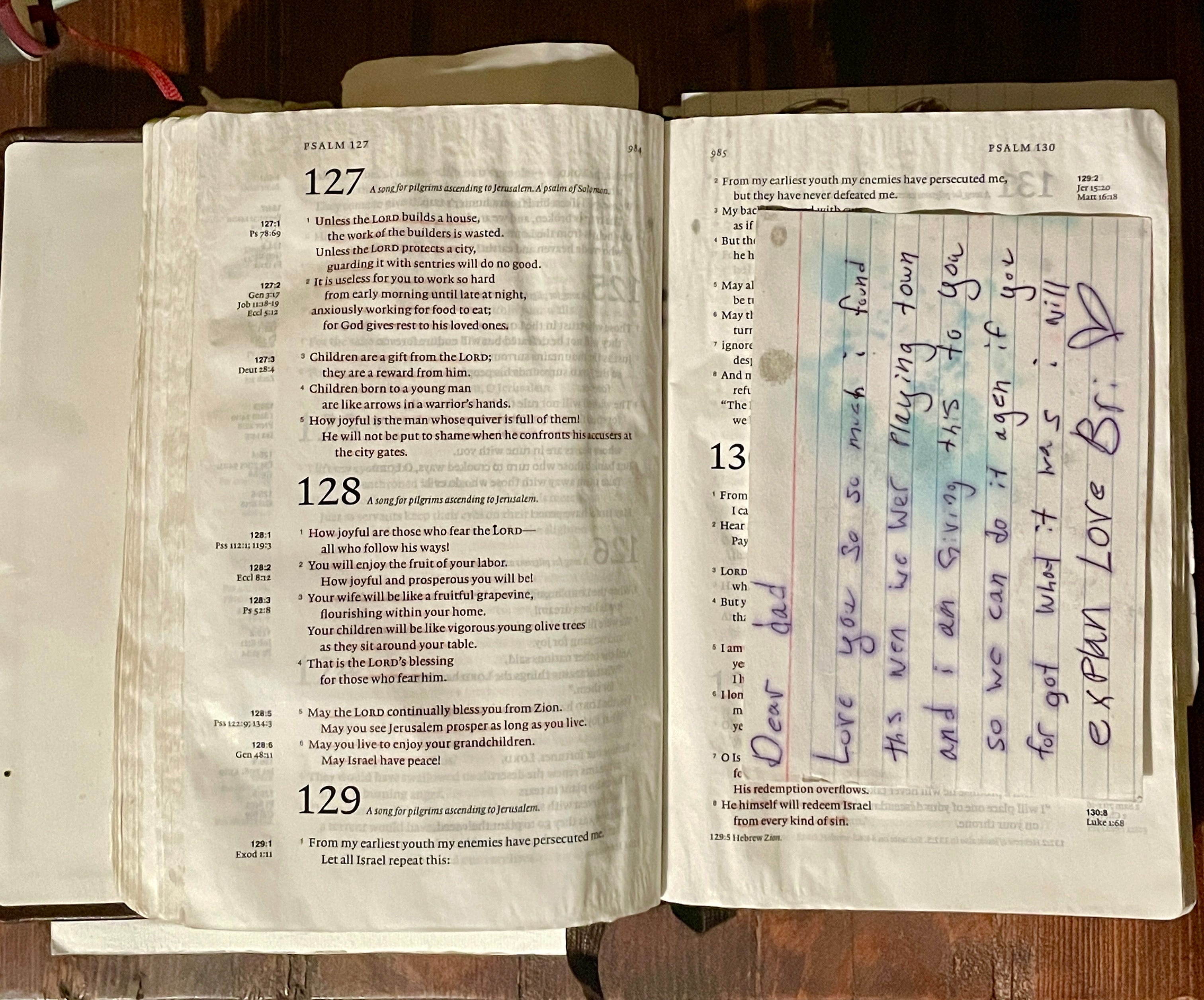
This is my calf-skin heirloom, Tyndale Publishers New Living Translation. A few years ago, a year after I bought it, I left it and my journal out by the fire pit—I study there often in the cold months, early. It rained. And ruined both. But I’ve kept it and still use it. I keep notes from my daughters as bookmarks. This is an old one from Brielle when she was much younger. I use watercolor pencils for underlining.
Then I Read It Again—This Time Paying Attention to Structure and Words
On the second reading, I slow down.
I look for repeated words.
I notice contrast words like “but” or “yet.”
I circle logic words like “therefore.”
I ask who is speaking—and to whom.
I ask what kind of literature I’m reading.
You don’t read Psalms (Hebrew poetry) the same way you read Romans (a first-century letter). You don’t read Ecclesiastes the way you read Proverbs.
When you see “therefore,” ask the old question: what is it there for?
These small words carry weight. They reveal movement and expose structure.
This is where most people stop too early. They read once, grab an encouraging phrase, and move on. But Scripture is not a collection of fortune-cookie lines.
It’s argument.
It’s poetry.
It’s narrative.
It’s theology unfolding over time.
If you don’t learn to observe, you will always be dependent on someone else’s interpretation. Just because a famous pastor says it doesn’t mean we should swallow it hook, line, and sinker. Iron sharpens iron. We should do our own study and press into the deeper pools ourselves.
As we do, we recently left a service and broke down the sermon on the car ride home. My daughters asked what I thought about it, and I asked them what they learned, what spoke to them. When they asked me, I told them about an error I heard.
Now, this is not me criticizing the pastor or being an armchair preacher. It’s just me, noticing something I had previously studied in the text. I always approach Sunday worship, again, with palms up, ready to learn and hear from the Lord. But I’m also aware that we all need to be in the Word ourselves, studying. If I rely on someone else’s study all the time, I’m missing the depth of communion offered to me by God.
Sorry for that digression. Ok, back to paying attention and observation.
Years ago, the Pulitzer Prize-winning historian David McCullough explained a note he kept on his desk to The Paris Review. It read: “Look at your fish.” McCullough explained that it reminded him to observe, to see. He said:
“Insight comes, more often than not, from looking at what’s been on the table all along, in front of everybody, rather than from discovering something new. Seeing is as much the job of an historian as it is of a poet or a painter, it seems to me. That’s Dickens’s great admonition to all writers, “Make me see.”
What McCullough believed was essential for historians and writers is equally important for readers of the holy Scriptures.
Take your time.
See.
This isn’t a race. Quiet time with God is not some performative ritual. It’s a lived relationship that requires your attention, your passion, and your patience.

I Ask Questions—And I Don’t Stop Asking
Ok, this is where your Bible study comes alive.
Take John 1: “In the beginning was the Word … ”
Maybe you’ve read that verse a hundred times. Me too. But you know what? I was in the first several verses of John’s Gospel for several weeks this past year. It is deeply profound. I always learn something when I return to it. And you will discover that too when you ask questions about it. Questions like …
Why begin there?
Why not Bethlehem?
Why not the Jordan River?
Why go back before Genesis?
John is not reporting events. He’s not a biblical stenographer. He is theologizing the life of Christ. He’s telling us what it means.
When I hit a phrase like “the Word,” I don’t nod as if I understand it. I sit with it. I ask why that word was chosen. I trace how the concept develops. I let the question linger.
When Billy Graham died, one of his daughters said something beautiful: her mother made sure they read the Bible regularly. But her father made sure they asked questions about it. That’s the difference. Reading regularly is necessary. But questioning deepens understanding and communion.
And, remember, questioning is not doubt (that’s another post). It’s hunger.
I Read Whole Books When I Can
Especially the letters: Philippians. Colossians. Galatians. James.
They were written to be heard in one sitting. When you read them that way, you start to see the argument and logical flow. You see the problem being addressed and how the “therefores” connect.
And with books like Ecclesiastes, this matters even more.
If you proof-text Ecclesiastes, you’ll walk away confused. If you read it from beginning to end, you’ll realize it has a strange, unsettling coherence. It’s building toward something. And yes, Ecclesiastes is one of my favorite books in the Bible. Can you guess my other one?
Reading whole books guards you from isolating verses and building conclusions the author never intended.
I Journal What I See
And no, it’s not polished writing. It’s thinking on paper. I’ll jot down observations, questions, or patterns I’m noticing, or connections that might be forming.
Writing forces clarity. Writing is thinking.
If you only read and never write, your thoughts stay foggy. When you write, you discover what you actually understand and what you’re assuming.
Don’t overthink this step. Get a journal dedicated to your ponderings and let yourself go free in it. Think of God looking over your shoulder, saying, “Ah, yes, good question. Let’s tackle that together.”
Or …
“Yes, that’s a tough one. It’s not going to be an easy answer. Get it all out and let’s discuss.”

I Think Longer Than Is Comfortable
This may be the most neglected discipline.
In seminary and graduate school in England, the best advice I ever received wasn’t a technical insight. It was simple: “Tim, go have a think.”
Not for ten minutes. Not for an afternoon. Sit with it. My doctoral supervisor once told me to go have a think … for the entire summer. It was wonderfully freeing to give myself permission to study a concept for three whole months.
Here’s what I do when I “have a think.” I’ll go for a walk and let a phrase follow me. I’ll record a voice note as I process what I’m seeing. I’ll let a difficult passage sit unresolved for a while. I’ll even call my Dad to discuss it. An outside perspective, especially from someone who’s studied the bible decades longer than I have, is illuminating.
Depth rarely appears in the first five minutes. It arrives almost unnoticed. I’ve had verses or passages make sense to me after a nap or when I least expect them. Sitting with Scripture flies in the face of our culture. Speed is the only thing that counts. Immediacy!
But sitting with something of such rich importance has a way of carving new lines into your soul. It is after I sit with something for a while that the questions overwhelm my thinking, and I need to go deeper and get more precise.
Only Then Do I Reach for Commentaries
I am not anti-scholarship. Of course not! I spent a good portion of my life pursuing it. I am deeply grateful for it. But I try not to consult commentaries first.
If I go there too quickly, I risk inheriting someone else’s framework before I’ve wrestled with the text myself. (See above.)
Commentaries are best used to refine, sharpen, or challenge what you’ve already seen—not to replace the process entirely.
Most confusion around Scripture doesn’t begin with ill-intent. It begins with dependency. I can’t tell you how many times I’ve wanted to scream when I hear someone post or talk about how their thinking changed on something biblical after hearing so-and-so-scholar say this-or-that.
If your understanding of the Bible is built primarily on what others say about it, you will inevitably absorb their assumptions—some faithful, some cultural, some reactive. It can get dangerous, in a bad way, quickly.
The only way to discern the difference is to become literate in the text itself.
Here’s A Simple Way to Begin
If you want to try this without overcomplicating it, try this:
Pick a short chapter.
Pray.
Read it straight through.
Read it again and observe. List your observations.
Ask questions.
Write down what you notice.
Sit with it tomorrow.
Remember, you don’t need a theology degree. You need attention, patience, and a willingness to stay. Start small. Pick a chapter. Sit down tomorrow morning and actually read it—slowly, with your questions turned on. Fight for ten honest minutes and build from there. It’s okay to spend a week on one verse, on one word—like Logos. Sitting with God’s living Word is more rewarding than we know. All it takes is some dedicated time, persistence, and the heart that yearns to know more of God.

Going Deeper Without Getting Weird
Above, I mentioned that I read from a Greek New Testament. What I didn’t unpack is the layer I explore before I ever open a commentary. This is the step most people skip.
Below, I’ll show you exactly what I look at, and how you can do it too.