

The Great Sabotage
Issue 1 - We are Not Alone: Disclosure, Mystery, and the Fever of Modern Imagination

Once a year, I open these doors a little wider. This is the only 50% discount I run all year. I’ve asked management about bringing it back at Christmas. Apparently, the elving schedule is non-negotiable. Paid subscribers receive full access to The Great Sabotage (monthly cultural field reports), commenting and full archive, behind-the-scenes research and commentary, private audio reflections, and occasional video dispatches. So if you’ve been circling the paid tier, this is your moment to step inside.
Issue No. 1 — We are Not Alone
Disclosure, Mystery, and the Fever of Modern Imagination
We are not alone.
We inhabit a world that is practical and material, yes, but also mysterious and metaphysical. The Christian faith has always held that reality is populated by both physical and spiritual beings. Until recently, this was not controversial. For most of human history, the world was understood as animated, alive with presence. Something existed beyond the human frame, call it God, Allah, the Tao—something not contained within matter.
But the modern era redefined the conversation.
The “material” view of the universe has dominated our imagination for centuries. Thinkers like Iain McGilchrist have long argued that we have lost our sense of depth and beauty. Perhaps that’s why we’ve finally begun to reacquaint ourselves with the sky and are looking up again.
Literally.
We’re looking up and are finding “signals” or “signs” as we wean ourselves away from looking down and swiping at notifications. Our febrile culture, long numbed by machinery, seems hungry for transcendence again. And this is what I’m noticing. The conversation about UFOs and extraterrestrial life isn’t happening on just one level. It unfolds across three frames at once: scientific observation, theological imagination, and technological culture. This essay isn’t an attempt to prove or disprove alien life. It’s a venture to understand how those three frames shape what we think we’re seeing.

I ran across the “Look Up: Disclosure is Upon Us” article, and I was caught not just by the alien-ness of it all, but also by the cosmic instinct behind it. It was a melding that I loved. This world of ours is far stranger than our modern frameworks allow. And larger than mathematics alone can capture. It’s more alive than physics by itself can account for.
And suddenly, the conversation has shifted toward the sky.
UFOs and extraterrestrial life are no longer fringe science fiction. Our government is addressing the subject. Hearings are being held, and entire media ecosystems are forming around them. Entire religious subcultures now orbit the supernatural, the apocalyptic, and the possibility that we are not alone in the universe.
I half expect Buck Rogers to reappear on Netflix. Or for Elon Musk to start clicking the next time he talks about Mars.
Materialism, in philosophy, posits that reality is entirely composed of matter. According to this perspective, everything that exists is physical, and all processes, including mental states and consciousness, arise from material interactions.
The Kraus piece reminded us that our times already feel apocalyptic and surreal. Against that backdrop, the alien/UAP talk seems right on time. She pointed to the recent (2023) Congressional Whistleblower hearing, which shows the seriousness this topic has become. It’s worth watching.
What I appreciated most, though, was Kraus’s decision to invite a Christian voice into the discussion: Allie Rae. Allie’s words struck a chord. She encourages us to “Look up.” If we all did more looking up, she says, we’d be better off as a society. I agree.
Her journey began humbly enough. She began taking night walks and looking at the stars—one of my favorite things to do. She started this liturgical skywatching, not to see UFOs, but as a therapeutic ritual—reenchantment walks, I’d call them.
Over time, she learned to watch the sky and began to notice anomalies … during daylight hours, and it unsettled her. It forced deeper questions: What does this mean for my faith, my theology? How would I relate this to my children?
She writes:
As a Christian, I had no idea how to categorize this within my theology, and no one in the church had answers for me. I was disturbed but determined to understand the new reality unfolding before me. And throughout this 10-year journey, these discoveries didn’t pull me away from my faith; they expanded it.
I love how her journey expanded her faith.
The further she ventured, the more cautious she became:
… peeking behind the curtain can create a profound paradigm shift—one you’re never fully prepared for. It can be jarring. So take it from someone who’s walked this road: proceed with caution. Have an open mind, but guard your heart. Because the deeper you go into the UFO subject, the more it becomes less about lights in the sky and more about life’s biggest questions: What is the true nature of reality? What do you believe about the unseen? How anchored is your faith?
This knowledge has a way of holding up a mirror and demanding answers to questions you may not be ready to ask. So step in, but stay grounded—and hang on tight.
Her question: What is the true nature of reality is something I want to come back to, because it hums beneath all of this.
Kraus also mentioned a prediction circulating: that government disclosure had just a 10% chance of happening before 2027. Little did she know how prophetic her piece actually was. The very next day on Truth Social, President Trump said he would direct the Department of Defense and other federal agencies to “begin the process of identifying and releasing Government files related to alien and extraterrestrial life, unidentified aerial phenomena (UAP), and unidentified flying objects (UFOs), and any and all other information connected to these highly complex, but extremely interesting and important, matters.”
So, the volume of reports on aliens and UAPs continues to rise. But remember, louder is not the same as truer.
My question at this point is, are we now infatuated with the possibility of something beyond our planet being real, or are we finally coming to grips with the mystery that floods our existence in the first place?
Culturally, has our media conditioned us to automatically look at celestial anomalies and think, “Aliens,” or has our innate yearning for transcendence latched onto science fiction tropes and said, “It feels good to not be alone”?
There’s a natural human curiosity about these questions. The further we see into our universe, the more our curiosity swirls. That’s good. But does the size of our universe imply the possibility of distant life or something more personal to us and how we relate to its Creator?
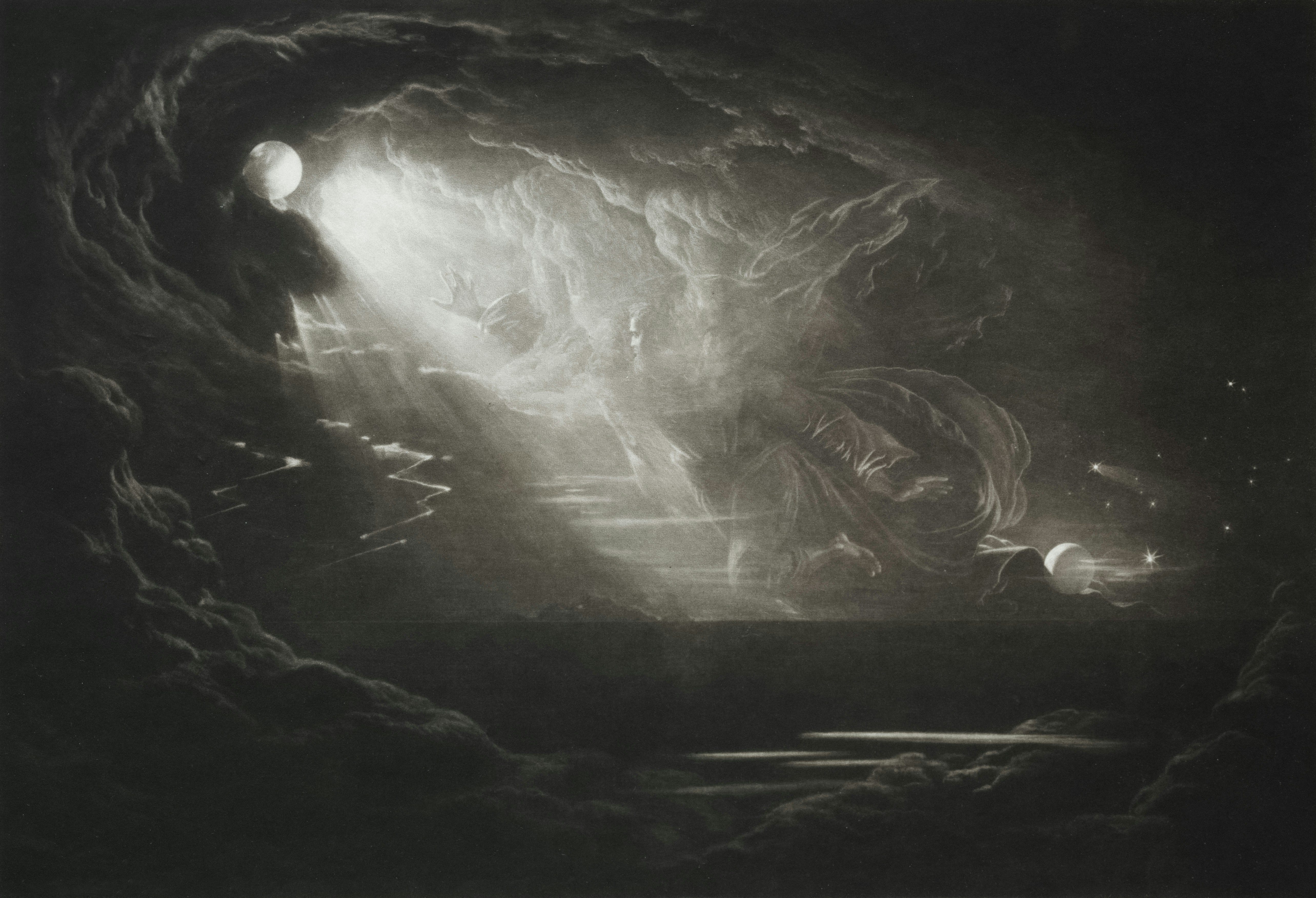
Why for us men more than others? If we find ourselves to be but one among a million races, scattered through a million spheres, how can we, without absurd arrogance, believe ourselves to have been uniquely favored?
—C.S. Lewis, “Religion and Rocketry,” in The World’s Last Night and Other Essays
The Cosmic Frame: All Things Visible and Invisible
The Christian imagination has never required a small universe. Long before modern science speculated about extraterrestrial life, Scripture described a cosmos already alive with more than human presence. Biblical writers give accounts of angels, principalities, powers, heavenly hosts, and unseen realms.
Christianity does not begin with the assumption that we are alone. Quite the opposite. It begins with the claim that reality is fuller than what we see. And that reality is held together by a person: Jesus Christ.
Paul writes that Christ is the one …
through whom all things were created: things in heaven and on earth, visible and invisible … and in him all things hold together.
(Colossians 1:16–17)
John opens his Gospel with the same cosmic perspective:
Through him {Jesus} all things were made; without him nothing was made that has been made.
And Hebrews declares that Christ is …
upholding all things by the word of his power.
But my favorite is the more nebulous passage in Proverbs 8 where The Teacher describes how “Wisdom” was side by side with God at creation, delighting in the work of creation, and rejoicing in the whole world and delighting in mankind. Many scholars attribute this description of Wisdom to the Logos—Jesus Christ. It shows us the intimate side of God’s creating through wisdom, through Jesus, his most precious creation: the human race.
And in the delight of creation, there is the unseen realm. “All” that has been made includes the invisible spiritual realm we cannot see, though we do sense1 and encounter it through the physical senses.
So, before we ever ask whether life might exist elsewhere, Christianity has already placed the entire universe—known and unknown—within the sustaining authority of Christ. We inhabit a cosmos “brim full of existence”2 because God himself is. He is such that “He can give existence away, can cause things to be.”3 And what we know of existence begins with humankind, animal, and vegetable life, right here.
Does that mean Christians can’t be curious? Absolutely not. But curiosity is different from being unmoored in our faith because of the possibility of life on other planets in other galaxies.
The cosmos can be strange without being godless.
If we were to find life elsewhere, the universe would not suddenly expand beyond Christ’s reach. It would simply give us a deeper understanding of the universe he already holds and sustains.4
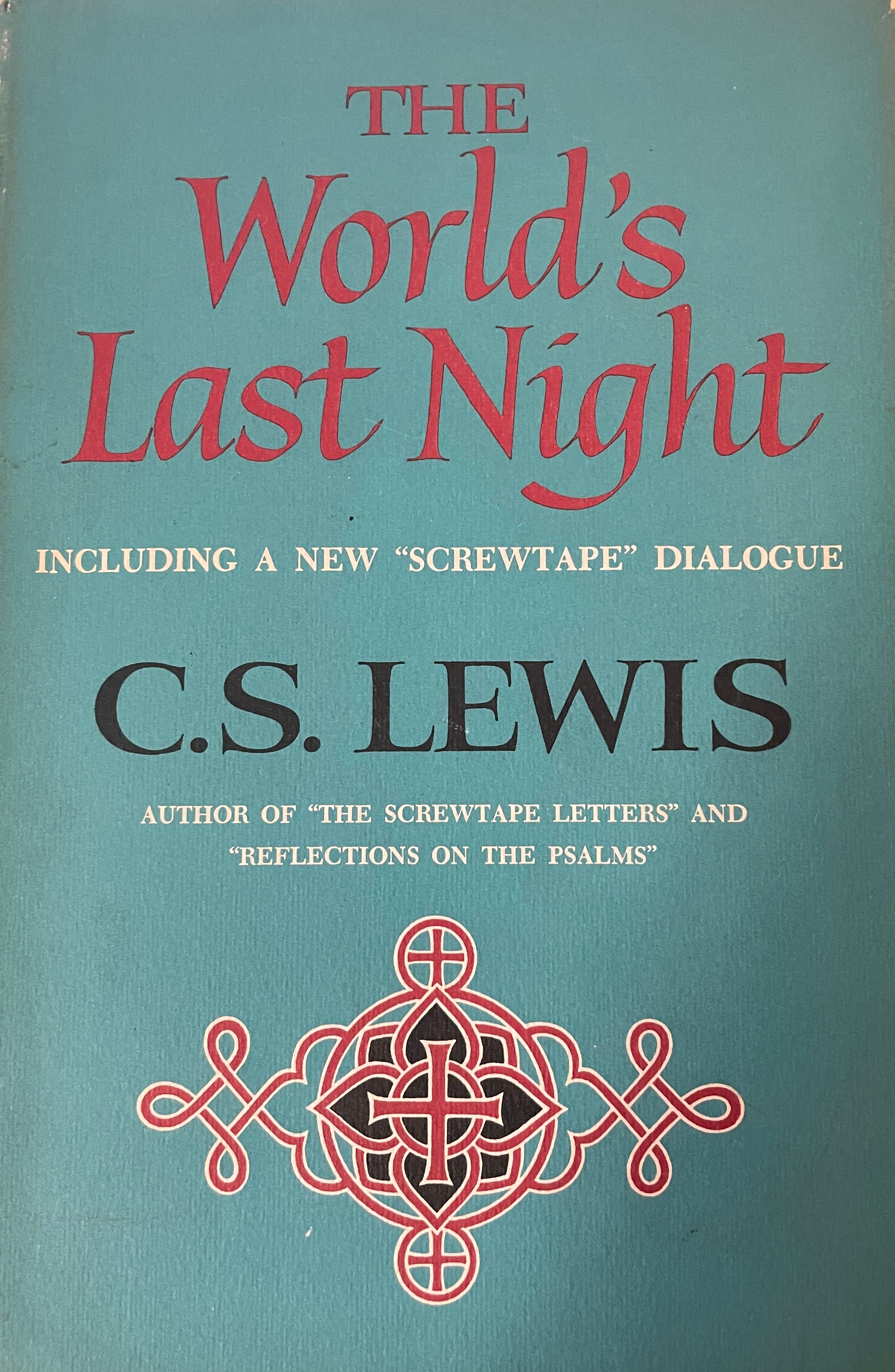
C. S. Lewis anticipated this conversation decades ago. Above, I included a quote from his essay Religion and Rocketry asks:
“If we find ourselves to be one among a million races scattered through a million spheres … how could we, without absurd arrogance, believe ourselves uniquely favored?”5
The line is sometimes used to suggest Lewis believed in extraterrestrial life or civilizations. But Lewis isn’t declaring belief in extraterrestrials here. He’s staging an objection—something he often does in his writing—then examining it. It’s a thought experiment.
Lewis argues that we simply do not know:
whether other rational beings exist
whether they are fallen
whether redemption would take the same form
or whether Christ’s incarnation, rooted in one world, could still be cosmically sufficient
His conclusion? Christian theology, he suggests, does not need to rush ahead of revelation or evidence. It has room for mystery without surrendering coherence.
At timestamp 49:21, Dr. Wiseman grapples with the question of whether there is life on other planets.
And if there is room for mystery and the uncanny, do we really need to rename what already exists? I mean, here, angels and demons. Some Christians want to take the UAP/Alien conversation and baptize it in modern lingo. We’re now using terms like “interdimensional” beings. Why?
Christianity has always affirmed the existence of the “unseen realm.”6 The tradition accepts the view that angels are intelligent, personal, spiritual beings created by God, and that demons are fallen angels, with the Satan being the prince of the fallen angels.7
The question, then, is not whether unseen realities exist. That has been Christian orthodoxy for two millennia. The question is what our experiences actually warrant us to conclude. This was Lewis’s point; the presence of mystery doesn’t give us permission for open speculation without discernment. And the existence of the supernatural does not license sensationalism.
But let’s pause for a moment.
Can we step back and take all this in?
What I’m saying here isn’t new information. It’s the belief of billions of people for the last 2,000 years. Indeed, up until 300 years ago, the existence of the supernatural realm—and not just the existence, but its active participation in human life was a given for all cultures dating back to the earliest civilizations. The “world view” was known as cosmic piety.
But go beyond belief. It’s a lived reality. Here we are, on Substack, saying that angels, demons, and an entire invisible realm exist and participate in our lived reality.
Does anyone else think that sounds crazy?
It does. And that’s why it’s also beautifully and wonderfully and mysteriously amazing. That’s why we can look at the sky and gasp—because we have no clue what exists out there in terms of animal or vegetable life. We have no idea whether intelligent life exists or whether any such creatures have a soul.
And yet at the same time, we know that somewhere behind the veil of material reality, Cherubim exist and guard the throne room of God.
Who needs aliens when we have Cherubim?
The Great Sabotage cultural deep dive happens every third Thursday of the month. Upgrade to a paid subscriber and receive The Sabotage File and join the community
Our Place Among the Stars: The Technological Shift
If you do a quick Google or AI search, you will find that sky-sightings date to pre-twentieth century. Here’s a quick list:
a clarifying moment in UFO history - *Note: I included this one because I found it while researching Victorian phantom balloons. This article documents the China balloon surveillance of 2023, the same year as the congressional whistleblower hearings.
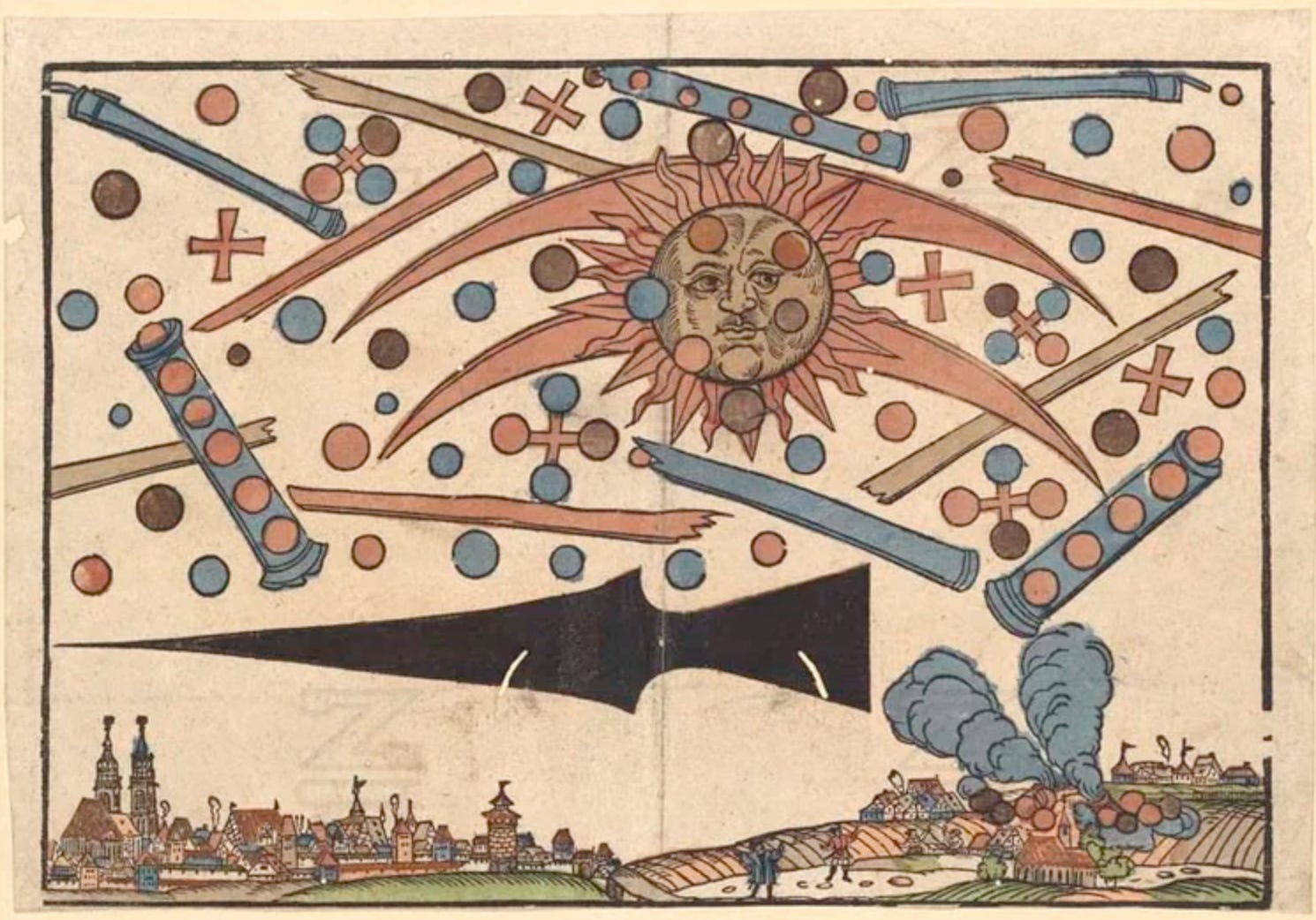
The modern UFO imagination didn’t emerge in a vacuum. It rose alongside the most dramatic technological explosion in human history. Flight, radar, nuclear testing, satellites, drones (the first drones date to WWI), digital imaging, and global information networks (World Wide Web, thank you Tim Berners Lee) all reshaped how we see the sky. What earlier generations might have interpreted as omens, angels, or natural phenomena, we now interpret through the language of machinery, surveillance, and extraterrestrial technology.
The heavens did not suddenly become busier. How we interpret the sky changed.
In the twentieth century, the sky became technological. We traded natural and supernatural wonder for science fiction. Because of Hubble, the James Webb Space Telescope, the Euclid Space Telescope, and others, we take space imagery for granted.
If you add the proliferation of personal computers, global connectivity, smartphone cameras, and algorithmic distribution systems, we get a world that whirs in an unprecedented feedback loop. An anomaly in one corner of the world now travels globally in seconds via TikTok or Instagram. Interpretation spreads faster than verification. Speculation becomes community. Community becomes conviction.
And what happens? In such an environment, mystery multiplies. Why? Is it because the universe changed? Or is it because information transference made it so?
Unlike pre-modern civilization, we live in a world of noise: profuse light pollution, an orbital field trashed by satellites, and digital noise—visual and aural. We can barely see the stars, but we’ve convinced ourselves that something is hiding in them and coming for us.
Here’s what astounds me. And I think it astounds me more about Christians obsessed with UAPs and aliens.
It’s that we seem to be more obsessed with the inevitable arrival of extraterrestrial life than with an ancient sky that holds the light from the beginning of time itself.
The anomaly isn’t floating rectangles. Its that the night sky has remained stable to human eyes for millennia.8 We walk beneath the beginning of the universe every night—there it is, in still mode, while we scroll and text. We look down, craning our necks for the next dopamine hit, when our ancestors spent their time looking up, navigating oceans by the stars and planting crops by the constellation rhythms.
Take a moment and think about what our world of mimicked light creates. We pack into cities aglow with the wash of screens and lights that never turn off. The flood of fake light removes scale from our environment. We can’t see the sky, so we don’t know how to interpret its massive size and depth. What is there to fear in a world of constant (fake) light?
But step into the Utah wilderness, and suddenly the world grows uncomfortably large. There is cold, darkness, thunder, and silence. That kind of scale creates humility. That’s what awe does. It creates a creaturely awareness. This is what Rudolf Otto called the numinous—the sense of the divine in natural phenomena.
Dvořák and the Whale Stars
As I was thinking through this piece one night, I sat at the fireplace and listened to Antonín Dvořák’s cello concerto in B minor. Yo-Yo Ma was the cello soloist. The piece is 50 minutes long. As I listened, I thought, “How can we think of aliens when no one has figured out the mysterious power music has?” Music is a physical and metaphysical anomaly. The stars of the universe literally hum in tonal chorus.
Music is a language—not just in mathematical scales, but in spiritual resonance. Even atheists and agnostics describe Bach’s cello suites as “transcendent” and “touching the divine.”
To me, the possibility of alien life speaks to the human desire to touch what lies in the beyond. I don’t know where the power of music comes from, but I know it is not a human invention. God created it and imbued the world with it. This is why Dvořák’s cello concerto can captivate the mind and body. Because it feels like it’s coming from somewhere beyond us—beyond what human reasoning alone can produce. We sense a presence; we scramble to describe it, paint it, capture it in verse, but alas, our feeble imaginations can only grasp at metaphor to describe what is both in our world and outside it.
My daughters keep hounding me to take them to Utah. I’ve told them many stories of the stars there and in Durango. Stars I called “the whale stars” because they look as though they are breaching reality. They want to look up and see. But what they really want to do is feel—they want to feel the stars. Their presence in the sky, their vastness slung out over the horizon, the Milky Way dripping into the desert unencumbered.
They want an alien experience.
And so do we all.

The Sabotage File
If our culture is febrile—always one headline away from panic—then the question isn’t just what we believe about the sky. It’s how we train our attention beneath it. In this week’s Sabotage File, I want to share how I personally manage fertility through beauty.